
China Clay (Kaolin) Processing Plants
Custom-tailored kaolin washing systems that deliver the particle size and brightness each user industry demands.
PlatformsMicrograder
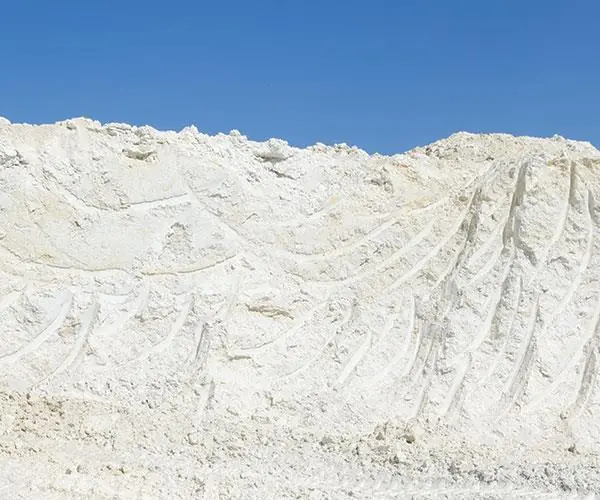
China clay (kaolin) processing washes crude clay with water to achieve grit removal, sizing, attrition, filtering and drying. Brightness is raised by magnetic separation, flocculation or flotation to remove iron and titanium: Fe levels of around 1.5% in recovered clay are brought below 1%, delivering 90–92% whiteness at 300 mesh.
What is china clay?
Kaolin (china clay) is a hydrated aluminium silicate crystalline mineral (kaolinite), formed over millions of years by the hydrothermal decomposition of granite rocks. Hydrous kaolin is characterised by its fine particle size, plate-like or lamellar particle shape and chemical inertness.
The name is literal. Kaolin was the clay that made porcelain, the ware Europe imported from China and then spent two centuries learning to copy, and the mineral still carries the trade name. "Kaolin" and "china clay" mean the same material.
Because it forms where granite has decomposed in place, crude clay comes out of the ground mixed with what the granite left behind: quartz grit, mica flakes, and iron and titanium minerals. That is why processing starts with grit removal rather than with brightening. The clay itself is already white; the job is taking away everything that is not.
What separates kaolin from the clays it is often confused with is what it does not do. It is chemically inert, it does not swell with water the way bentonite does, and its plate-like grains lie flat, which is what makes it useful as a coating rather than only as a bulk filler.
What china clay is used for
Each industry that buys it is buying a different property.
-
Paper coats with it, and pays the most for it. Flat plate-like particles give a smooth, bright surface that takes ink cleanly, so paper coating sits at the top of the value chain and sets the tightest brightness and particle-size specifications.
-
Ceramics want a clay that fires white and holds its shape. Grades here are more generic than paper grades, which is why a deposit that misses coating specification can still sell.
-
Paint uses it as an extender: it adds opacity and body without the cost of titanium dioxide.
-
Rubber and plastics use it as a functional filler, where the inertness matters as much as the particle size, because the filler must not react with what surrounds it.
-
Glass takes it as a source of alumina.
Those requirements pull in different directions, and no deposit satisfies all of them, which is why grade is decided by the feed rather than chosen from a list.
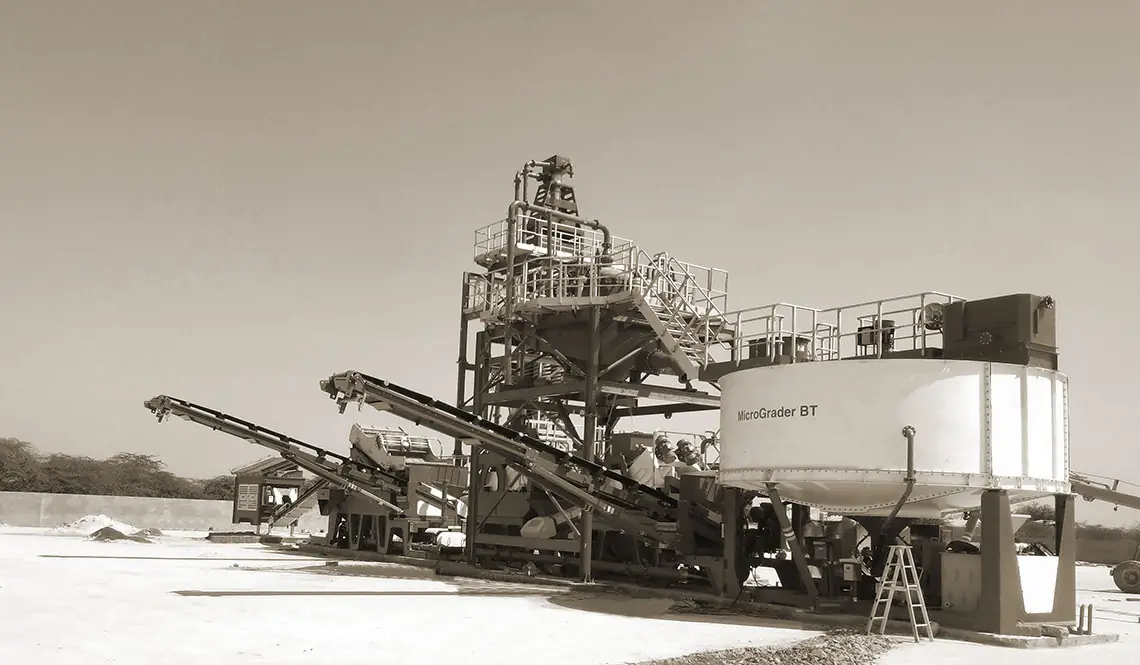
The washing and brightening process
Clay pigments are produced through a washing system with water as the process medium, achieving grit removal and sizing, and providing attrition, filtering and drying. Silica sand is often produced as a by-product, with uses in the glass industry, foundry sand and construction.
Brightness of clay fractions is achieved by one or more processes, magnetic separation, flocculation or flotation, removing iron, titanium, organic and other undesirable material. High-quality clay is evaluated on particle size range and L value (brightness). In our reference work, Fe was brought down from around 1.5% in the recovered clay to the desired level of below 1%, with TiO2 not an issue in that clay. CFlo has undertaken extensive test work across the classification technologies the company has evolved over the years to generate the specific fractions each user industry demands.
Product grades and typical characteristics
CFlo systems produce the full commercial range: levigated china clay powder, water-washed china clay powder, natural kaolin powder, and water-washed and natural lumps. Typical characteristics include:
- Whiteness: 90–92% for levigated and water-washed powders; 88–90% for natural kaolin powder
- Moisture: below 0.5% across all grades
- Particle size: 300 mesh powders with a 50 micron top cut
- Chemistry: levigated grade at 47–48% SiO2 and 37–39% Al2O3; natural kaolin at 74–75% SiO2 and 16–17% Al2O3
- Applications: paints, plastics, paper and cosmetics for washed powders; ceramics and rubber for natural grades
Custom-tailored, on the Micrograder platform
Each clay processing system is custom-tailored to the particle size distribution and chemical composition of your feed. The platform is CFlo's Micrograder fine classification range, running in the field at Suraj Minerals (published case study), and engineered as a Next-Gen 'Super' System: Super modular, Super smart process control that holds brightness and sizing while reducing water and power, Super easy app-guided installation and service.
Real plants in this application
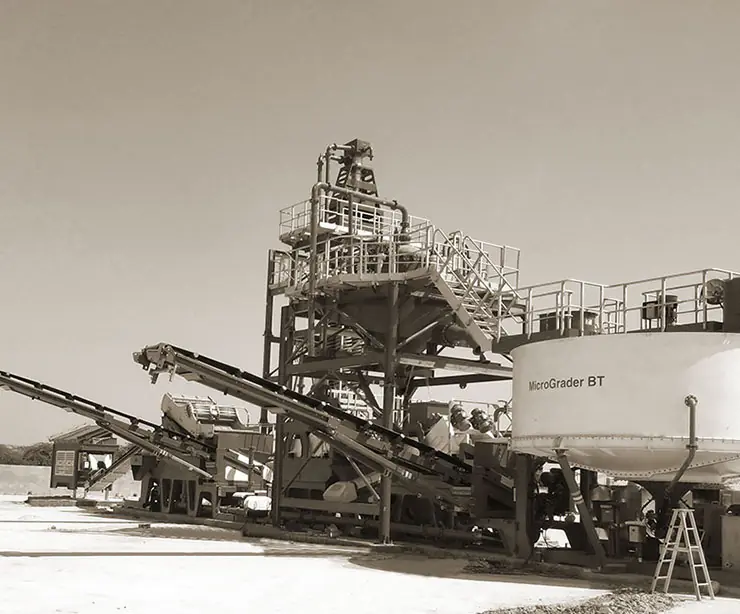
Machines behind these results: Micrograder
Frequently asked questions
What is china clay?
China clay is kaolin, a hydrated aluminium silicate mineral (kaolinite) formed over millions of years by the hydrothermal decomposition of granite. It is naturally white, chemically inert, and made of fine plate-like particles, which is what makes it valuable as a coating rather than only as a filler.
Why is it called china clay?
Because it is the clay that porcelain is made from. Europe imported the ware from China long before it could reproduce it, and the trade name stayed with the mineral. Kaolin and china clay are the same material.
What is china clay used for?
Paper coating, ceramics, paint, rubber, plastics and glass. Each buys a different property: paper wants brightness and a flat particle for print quality and pays the most; ceramics want a clay that fires white; paint uses it as an extender for opacity; rubber and plastics want an inert filler; glass takes it as a source of alumina.
How is china clay different from other clays?
Mainly in what it does not do. Unlike bentonite it does not swell in water, and unlike more plastic clays it is chemically inert. Its plate-like grains lie flat rather than packing randomly, which is why it can be used as a surface coating and not just as bulk filler.
What industries buy processed china clay?
Rubber, paper, ceramic, glass, paint and plastics industries all use kaolin, each with its own grade requirements for particle size and mineral content. Paper coating is the highest-value application; ceramic grades are more generic. Washed powders also serve the cosmetics industry.
How is kaolin brightness improved?
Brightness (L value) is raised by removing iron, titanium, organics and other undesirable material through one or more of magnetic separation, flocculation or flotation. In CFlo's reference work, Fe was reduced from around 1.5% in the recovered clay to below 1%, meeting the brightness target without TiO2 treatment.
What particle size does processed china clay achieve?
Standard powder grades are 300 mesh with a 50 micron top cut, across levigated, water-washed and natural kaolin products. Generating the specific fractions each industry demands is classification work, and CFlo has run extensive test work across its classification technologies to prove each cut.
What whiteness can a kaolin washing plant deliver?
Levigated and water-washed china clay powders typically reach 90–92% whiteness, natural kaolin powder 88–90%, and lump products 88–90%, all at below 0.5% moisture. The achievable figure depends on your feed chemistry, which is why every CFlo system is tailored after feed analysis.
Is anything else recovered from china clay processing?
Yes. Silica sand is often produced as a by-product of the washing system, with ready markets in the glass industry, foundry sand and construction. That by-product revenue improves overall project economics alongside the primary clay grades.
Why is every kaolin plant custom-tailored?
Because feed varies: each clay processing system is designed around the particle size distribution and chemical composition of your specific deposit, and around the grades you intend to sell. CFlo confirms the flowsheet through test work before the modular Micrograder-based plant is built.